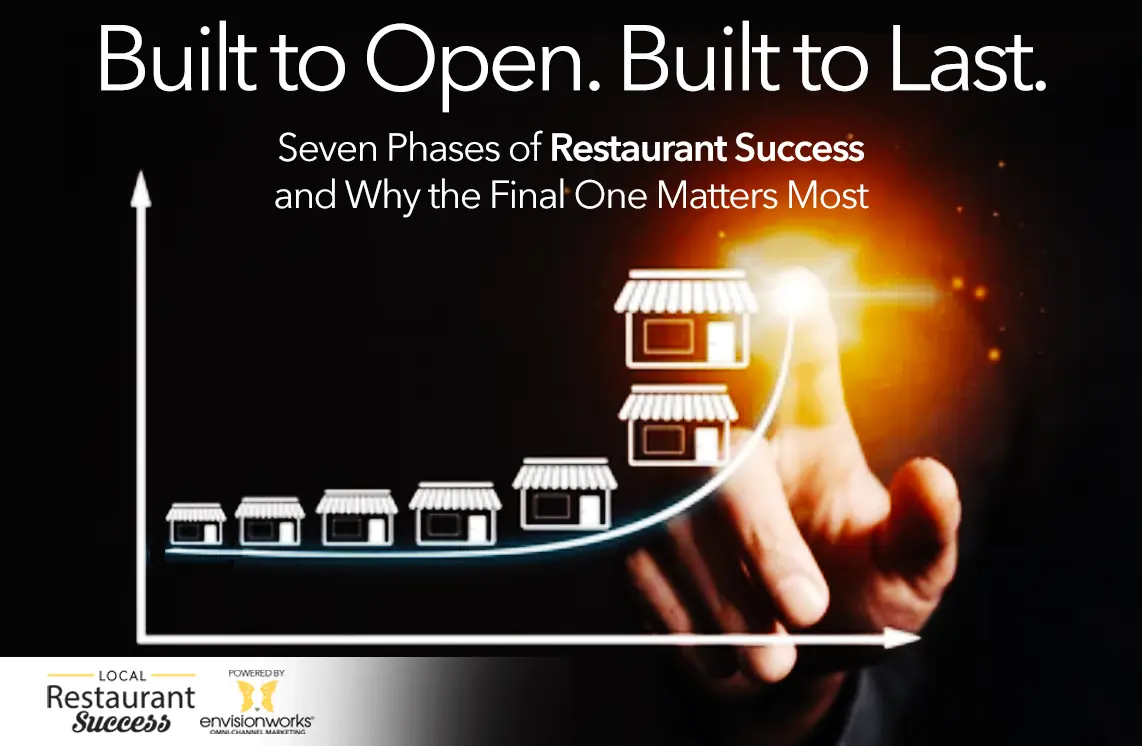
Opening a restaurant is one of the boldest moves an entrepreneur can make. Whether it is a first-time independent concept, a seasoned operator expanding into a new community, or a franchisee opening in a new state, the challenge is always the same:
How do you build something that lasts beyond opening day?
At Local Restaurant Success, we have worked with restaurants across the country at every stage of development. Over time, one pattern has become clear. Sustainable success does not happen by chance. It happens when restaurants move through intentional phases that build a strong foundation first, and a scalable business second.
Below are the seven phases we guide restaurants through, from vision to enterprise.
Phase 1: Concept Clarity and Vision
Every successful restaurant begins with clarity. This phase focuses on defining the core idea behind the business:
- What problem does the restaurant solve?
- Who is it truly for?
- Why should it exist in this market?
Too many concepts open based on passion alone. Passion is important, but without clarity, it leads to confusion in branding, menu development, and operations. Phase 1 ensures the concept is intentional, differentiated, and viable before money is spent and doors are opened.
Phase 2: Market Alignment and Positioning
A great concept still has to fit the market. In this phase, we align the restaurant with its local community:
- Demographics and psychographics
- Competitive landscape
- Pricing expectations
- Brand voice and guest experience
This is where positioning is refined so the restaurant does not just open, it resonates. When positioning is right, marketing works harder, guests return more often, and expectations are properly set from day one.
Phase 3: Operational Structure and Systems
This is where ideas become executable. Phase 3 is about building the internal systems that allow the restaurant to run consistently:
- Documented standard operating procedures
- Kitchen and front-of-house workflows
- Technology and reporting infrastructure
- Vendor and supply chain organization
Structure reduces chaos. Without it, operators are forced to make decisions on the fly every day. With it, teams operate with confidence and consistency.
Phase 4: Staffing, Training, and Culture
People power the business. This phase focuses on:
- Intentional hiring
- Clear role expectations
- Training systems that scale
- Culture that supports accountability and pride
Restaurants do not fail because of lack of effort. They fail because teams are undertrained, overwhelmed, or unclear. Phase 4 ensures the business is not dependent on constant micromanagement and that standards are upheld even when leadership is not present.
Phase 5: Financial Control and Cost Discipline
Revenue does not equal profitability. Phase 5 introduces financial discipline that protects the business:
- Cost controls and margin tracking
- Labor efficiency analysis
- Budgeting and forecasting
- Understanding true profitability by menu item and service period
This phase creates stability. Operators finally understand where money is made, where it is lost, and how to course-correct before small issues become major problems.
Phase 6: Performance Optimization and Smart Growth
Once the foundation is solid, optimization begins. At this stage, restaurants stop asking: “Are we busy?” And start asking:
- Where are the margins leaking?
- Which menu shifts impact profitability?
- How efficient is labor during peak hours?
- What drives guest frequency and loyalty?
Phase 6 focuses on refinement and precision:
- Advanced menu engineering
- Throughput optimization
- Predictive labor planning
- Vendor leverage and renegotiation
- Guest lifetime value tracking
This is where operators transition from surviving to leading. Profitability increases not by working harder, but by working smarter.
Phase 7: Replication, Leadership, and Enterprise Value
This is the phase most restaurants never reach. Phase 7 is not about operating a restaurant. It is about building a business that can grow, replicate, or transition. This phase answers critical questions:
- Can the business operate without founder dependency?
- Is leadership layered and scalable?
- Are systems transferable to new locations?
- Is financial reporting investor-ready?
- Is the brand documented and defensible?
Here, restaurants shift from income generators to assets.
A restaurant built around one personality has income value.
A restaurant built on systems, leadership, and documentation has enterprise value.
This is where:
- Expansion becomes realistic
- Partnerships become possible
- Exit strategies become options
Why Phase 7 Matters More Than Any Other
You cannot optimize chaos.
You cannot scale inconsistency.
You cannot attract serious capital without discipline.
Phases 1 through 5 create stability.
Phase 6 creates leverage.
Phase 7 creates freedom.
Without it, growth magnifies weaknesses.
With it, growth multiplies strength.
Restaurants do not succeed long term simply because they grow.
They succeed because they are built to grow.
So the real question is not whether you want to expand someday, but are you building your restaurant in a way that makes Phase 7 possible?